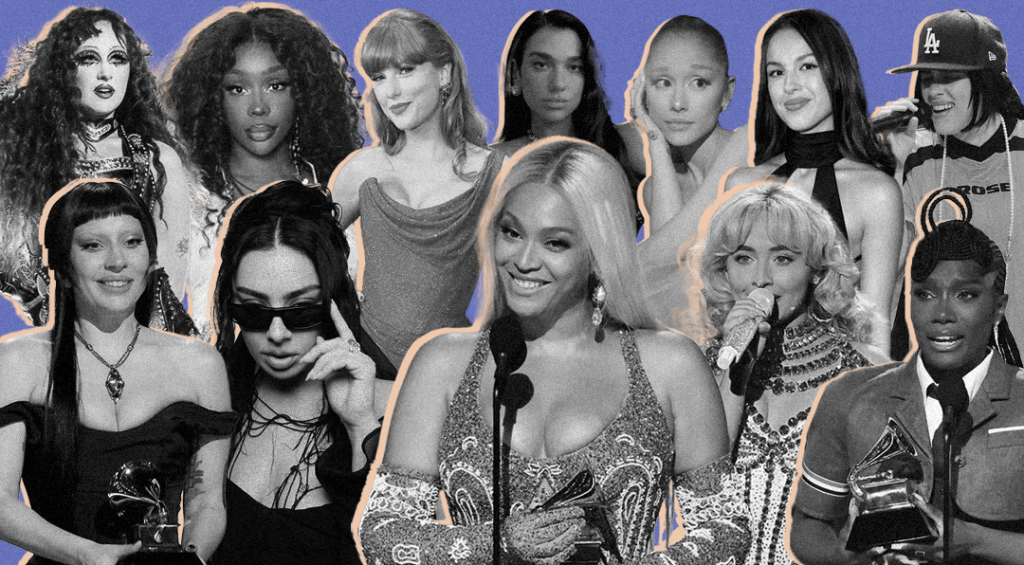
I’ve always been into music. It’s been the soundtrack to my best days and my worst ones, and Taylor Swift and Olivia Rodrigo are two of my favorite artists. I’m not writing this as a hater. I’m writing it because I love them, and because the toxicity around their music is turning womanhood in the industry into a hostile environment, for the artists and for the fans.
When a man writes an album about his breakup, critics call it “raw” and “vulnerable.” When a woman does the same, she is “obsessed,” “petty,” or “playing the victim.” The industry has a long habit of treating male pain as art and female pain as gossip, and fan culture has copied that habit.
The male standard
Let’s start with how the men are treated, because the comparison says it all.
- Drake and Kendrick Lamar traded some of the most personal and vicious songs in recent hip-hop, and the conversation was about bars, strategy, and who “won.”
- Ed Sheeran has built a career on songs about exes and heartbreak and is seen as a sensitive everyman. When he was sued over comparisons to Marvin Gaye’s music, he won, while Robin Thicke lost a similar case, and it was treated as a legal matter, not a flaw in his character (Westfield, 2026).
- John Mayer has written about his relationships for years, and the focus is rarely on whether he dates too much.
- Justin Timberlake released “Cry Me a River” after his breakup with Britney Spears. He got praised as an artist, while she was the one who got torn apart by the media.
- Chris Brown pleaded guilty to assaulting Rihanna in 2009. He still tours, still charts, and still gets nominated for awards.
- Kanye West has had controversy after controversy, and he kept getting platforms, collaborations, and album rollouts for years.
Now put a woman in any of those situations and notice how fast the tone changes.
Taylor Swift: the original case study
For years, Swift’s songwriting about her relationships was reduced to a joke: she dates men to write songs about them. Mayer, Sheeran, and Drake all write about relationships too, and none of them got a “serial dater” label that followed them everywhere.
The sharpest example came in 2016. After Kanye West released a song with a lyric about Swift, a phone-call clip released by Kim Kardashian was edited to paint Swift as a liar. The snake emojis took over her comments, #TaylorSwiftIsOverParty trended, and she largely vanished from public life for a year. The man whose lyric started the dispute faced far less lasting backlash.
Her fight over her master recordings tells a similar story. When Scooter Braun’s company acquired her old catalog in 2019, part of the public reaction treated a woman wanting to own her own work as a diva moment instead of a business dispute. She responded by re-recording her albums, which many industry observers see as a landmark in artist ownership.
The whole story: Taylor, Olivia, and the lawsuit that never happened
This is the perfect example of how social media turns a normal industry practice into a war between two women. So let’s go back to the beginning, because most people skip it.
2020 to early 2021: they were fans of each other. Olivia was a huge Taylor fan before she was famous. MTV posted a video of her singing “Cruel Summer” in April 2020, and Taylor shared it on her Instagram Story (Nicki Swift, 2021). When “drivers license” took off, Taylor commented on Olivia’s post to say she was proud of her (MEAWW, 2021). Nothing about this looked like a feud.
May to July 2021: the credits. When Sour came out, fans noticed that parts of Olivia’s songs sounded like Taylor’s. Olivia credited Taylor and Jack Antonoff on “1 Step Forward, 3 Steps Back” for re-recording an element of “New Year’s Day.” She later added Taylor, Antonoff, and St. Vincent to “Deja Vu” for the bridge that resembles “Cruel Summer” (PinkNews, 2024). That’s a normal industry practice. You borrow from another song; you credit the writers. Adding credits afterward has become common now that plagiarism lawsuits are expensive and unpredictable (Westfield, 2026).
August 2021: Paramore. Then fans compared “Good 4 U” to Paramore’s “Misery Business.” Hayley Williams and ex-guitarist Josh Farro were given co-writing credits, and sources said both teams were in touch before the song’s release (Rolling Stone, 2021). One report says Farro pushed for credit, and that Olivia’s team decided to add it (ClutchPoints, 2023). That’s where it snowballed: once one credit was added, Olivia’s team added credits for the other artists who had inspired her.
Where the lie started. Somewhere in the middle of all this, people started saying “Taylor sued Olivia.” There’s no evidence for that. The credits never went to court, and the whole thing was handled between the teams (What’s Trending, 2023). There’s no evidence that Swift took legal action; it’s more likely the teams reached an agreement behind the scenes after Olivia publicly named Swift’s song as inspiration (Westfield, 2026). The lawsuit story took off because the credit process happened behind closed doors and nobody explained it, so fans filled in the blanks with the most dramatic version they could think of.
Who got hurt? Olivia did the right thing by crediting other writers, and she got dragged for it. Some people decided that crediting others meant she was a thief. She told Time that it was frustrating to see people discredit and deny her creativity (Soteriou, 2023). Even when she was accused of lifting a riff for “Brutal,” Elvis Costello publicly praised her (Westfield, 2026).
2023 to 2024: the “feud” that wasn’t confirmed. When “Vampire” came out in 2023, fans decided it was about Taylor. Olivia answered the rumors directly, and the headline from her Guardian interview was that she said she doesn’t have “beef with anyone” (Yahoo News Malaysia, 2023). Then at the 2024 Grammys, Taylor was seen singing and dancing along during Olivia’s performance (PinkNews, 2024).
Did they fall out? Maybe, and that’s fine
I’m not going to pretend the two of them are best friends. Olivia and Taylor stopped being publicly close after 2021, and it’s possible there was a falling out, since people drift apart or get hurt even without a lawsuit. Reports in 2023 noted the two hadn’t mentioned each other publicly since 2021 (What’s Trending, 2023).
But look at what’s different. Two women who stop talking is a normal thing that happens to people. “Taylor sued Olivia” is a made-up story that paints one of them as the villain. The first is private life. The second is a rumor with a victim and a villain, and it came from fans. That’s where the toxic fandom comes back.
The “blocking” rumor
The blocking story is the same pattern again. Every few months, a post goes viral saying that one of them blocked or unfollowed the other, and that proves the feud. I looked and couldn’t find any confirmed report of either of them blocking the other. What I did find is that neither Olivia nor Taylor has directly addressed the renewed speculation (International Business Times UK, 2026).
Think about what that means. A follow, an unfollow, or a block is something you can’t verify from the outside, and even a real change doesn’t tell you why it happened. Olivia, for example, has joked about following almost nobody on Instagram and using a private “finsta” account to lurk (Gomez, 2023), so a screenshot of who she does or doesn’t follow doesn’t prove anything. A lot of fans treat “I can’t see it” as “it must have happened,” and that’s how a rumor turns into a “fact.”
We don’t have to pick a side or decide who’s guilty. The honest answer to “did they fall out?” is: we don’t know, and it’s not ours to know.
Olivia Rodrigo and a fandom out of control
Olivia’s “drivers license” broke streaming records in 2021, and the reaction showed how quickly a young woman’s success becomes a battlefield. Fans decided the song was about Sabrina Carpenter and turned that rumor into harassment. Rodrigo later said she remembered people being “so weird and speculative about stuff they had no idea about” (Robidoux, 2021).
Olivia herself saw the pattern. She has said it’s toxic for young girls to watch women who are just sharing their art be torn apart for doing nothing, and that society needs to reexamine how it treats women in entertainment (Hola!, 2021). Part of her fandom heard that and kept going anyway.
This year, the pattern is getting harder to ignore
The cycle came back around in 2026. When Joshua Bassett published a memoir, viral posts claimed he was calling out Olivia, and fans went on to bash both him and Sabrina. The report on the episode says AI-generated summaries and misleading posts fueled the claim, while the book itself is about trauma, recovery, healing, and faith (Dutta, 2026). A rumor machine that started in 2021 is still running, now with newer tools to make fiction look like fact.
I want to be fair here. It’s a loud segment, not every Olivia fan. Toxic fandom isn’t unique to her. Swifties have harassed critics, and fan wars exist around nearly every major pop act. Bassett’s case also shows that men can be targets. But look at who takes the heaviest hits over a rumor about a man: the women.
How female fandom toxicity ruins it for everyone
Here’s the part that hurts me most as a fan. When women tear each other down, it doesn’t just hurt the people being attacked. It ruins the chance for everyone else.
- It scares off new fans. Someone curious about Taylor or Olivia sees the fighting in the comments and decides this isn’t a space for them.
- It gives critics free ammunition. Every pile-on becomes proof for people who say “girl music” and “girl fans” are hysterical.
- It protects the men. While fans are busy fighting over which woman is the villain, the guys in the story stay out of the spotlight.
- It pushes artists to stay silent. If any statement can be twisted into a new war, why would a young artist say anything at all?
- It hurts young women in the fandom. The same girls who say they love these artists for being empowering are learning that the way to show love is to attack someone.
Fandom as enforcement
Misogyny in fandom often hides behind loyalty. Fans protect “their” artist by attacking the women around her: the ex’s new girlfriend, the rival, the collaborator. Rarely do they hold the man accountable. The woman becomes the villain by default.
It also shows up as entitlement. Chappell Roan spoke publicly in 2024 about fans who ignored her boundaries in public spaces. It’s a reminder that many fans feel they own the women they love.
Where men fit in
Men in music face pressure too. Toxic masculinity can stop them from talking about mental health, and male artists who stray from the expected image can be dismissed. But the hate directed at women is different in kind, because it targets who they are and not just their work.
Conclusion: let’s make music fun again
Music is supposed to be fun. It’s the song you scream in the car, the album that gets you through a breakup, the concert you talk about for years. Somewhere along the way, we turned it into a scoreboard. Who’s canceled? Who’s fighting with who? Who do we have to hate this week?
Most of the time, we don’t even know. We saw a screenshot, a clip with no context, a post that started with “apparently.” And we shared it anyway, and a rumor became “the truth,” and a real person had to deal with the fallout. The “Taylor sued Olivia” story is exactly that: a story with no lawsuit in it, that millions of people repeated anyway.
So let’s try something different.
- Look it up before you repeat it. Find the original source. Ask who benefits from you believing it. If you can’t find proof, don’t spread it.
- Hold the men to the same standard. If a woman gets criticized for a breakup song, ask what we said about the man who wrote one.
- Stop making women villains by default. Sabrina, Joshua, the exes, the rivals: none of them owe us a punishment.
- Love the artist without owning her. Respect her boundaries, her privacy, and her right to say nothing.
Music is supposed to be fun. It’s the song you scream in the car, the album that gets you through a breakup, the concert you talk about for years. Somewhere along the way, we turned it into a scoreboard. Who’s canceled? Who’s fighting with who? Who do we have to hate this week?
Most of the time, we don’t even know. We saw a screenshot, a clip with no context, a post that started with “apparently.” And we shared it anyway, and a rumor became “the truth,” and a real person had to deal with the fallout.
So let’s try something different. Before you repeat it, look it up. Find the original source. Ask who benefits from you believing it. If you can’t find proof, don’t spread it. Being a fan doesn’t mean defending your favorite artist by tearing down another one. Artists can like each other, work with each other, or just share a chart week without it being a war.
I want to go back to pressing play without wondering who’s in trouble today. I want to love a song without checking if the artist is “still allowed.” That only happens if we change how we act, one rumor we don’t share at a time.
Let’s make music fun again.
“I’m so sick of running as fast as I can, wondering if I’d get there quicker, if I was a man”
— Taylor Swift, “The Man”
APA REFERENCES
Dutta, P. (2026, June 29). Joshua allegedly called out ex Olivia Rodrigo as her song fueled hate against him, here’s the truth. Bollywood Shaadis. https://www.bollywoodshaadis.com/amp-articles/joshua-bassett-olivia-rodrigo-memoir-rookie-81259
Gomez, S. (2023, December 8). Olivia Rodrigo explains why she doesn’t follow anybody on Instagram. Hola! USA. https://www.hola.com/us/celebrities/20231208534885/why-does-not-olivia-rodrigo-follows-anybody-ig/
Grammys 2024: Taylor Swift shuts down Olivia Rodrigo feud rumours by dancing during her performance. (2024, February 5). PinkNews. https://www.thepinknews.com/2024/02/05/taylor-swift-olivia-rodrigo-drama-grammys/
Olivia Rodrigo. (2026). International Business Times UK. https://www.ibtimes.co.uk/olivia-rodrigo-interview-taylor-swift-rumours-1799592
Olivia Rodrigo confirms she has not attended Taylor Swift’s “The Eras Tour.” (2023). What’s Trending. https://whatstrending.beehiiv.com/p/olivia-rodrigo-confirms-she-has-not-attended-taylor-swifts-the-eras-tour
Olivia Rodrigo denies feud with Taylor Swift. (2023). ClutchPoints. https://clutchpoints.com/celebrity/olivia-rodrigo-denies-feud-with-taylor-swift
Olivia Rodrigo gives Paramore’s Hayley Williams a writing credit on “Good 4 U.” (2021). Rolling Stone. https://www.rollingstone.com/music/music-news/olivia-rodrigo-good-4-u-paramore-hayley-williams-writing-credit-1216729/
Olivia Rodrigo opens up about the pressures of fame and the dark side of social media. (2021, October 18). Hola! USA. https://www.hola.com/us/celebrities/20211018305439/olivia-rodrigo-pressures-fame-social-media
Olivia Rodrigo’s fans are freaking out. Here’s why. (2021). Nicki Swift. https://www.nickiswift.com/367001/olivia-rodrigos-fans-are-freaking-out-heres-why/
Olivia Rodrigo shuts down rumours that she’s feuding with Taylor Swift: “I don’t have beef with anyone.” (2023). Yahoo News Malaysia. https://malaysia.news.yahoo.com/olivia-rodrigo-shuts-down-rumours-164726128.html
Robidoux, B. (2021). Olivia’s getting backlash for waiting to defend Sabrina from haters. Elite Daily. https://www.elitedaily.com/entertainment/olivia-rodrigo-sabrina-carpenter-drivers-license-hate-backlash
Soteriou, S. (2023). Here’s everything you need to know about Taylor Swift and Olivia Rodrigo’s rumored feud amid speculation that “Vampire” is about Taylor. BuzzFeed News. https://www.buzzfeednews.com/stephaniesoteriou/olivia-rodrigo-vampire-about-taylor-swift-rumored-fallout
Taylor Swift and Olivia Rodrigo’s friendship timeline, feud rumors. (2026, June). Westfield. https://goodfest.westfield.com/2026/06/taylor-swift-and-olivia-rodrigos-friendship-timeline-feud-rumors/
Why did Olivia Rodrigo wipe off Instagram posts? Here’s proof she took Taylor Swift’s route to announce new music. (2021). MEAWW. https://meaww.com/olivia-rodrigo-deletes-instagram-new-cryptic-video-album-copies-taylor-swift-drivers-license


Leave a Reply